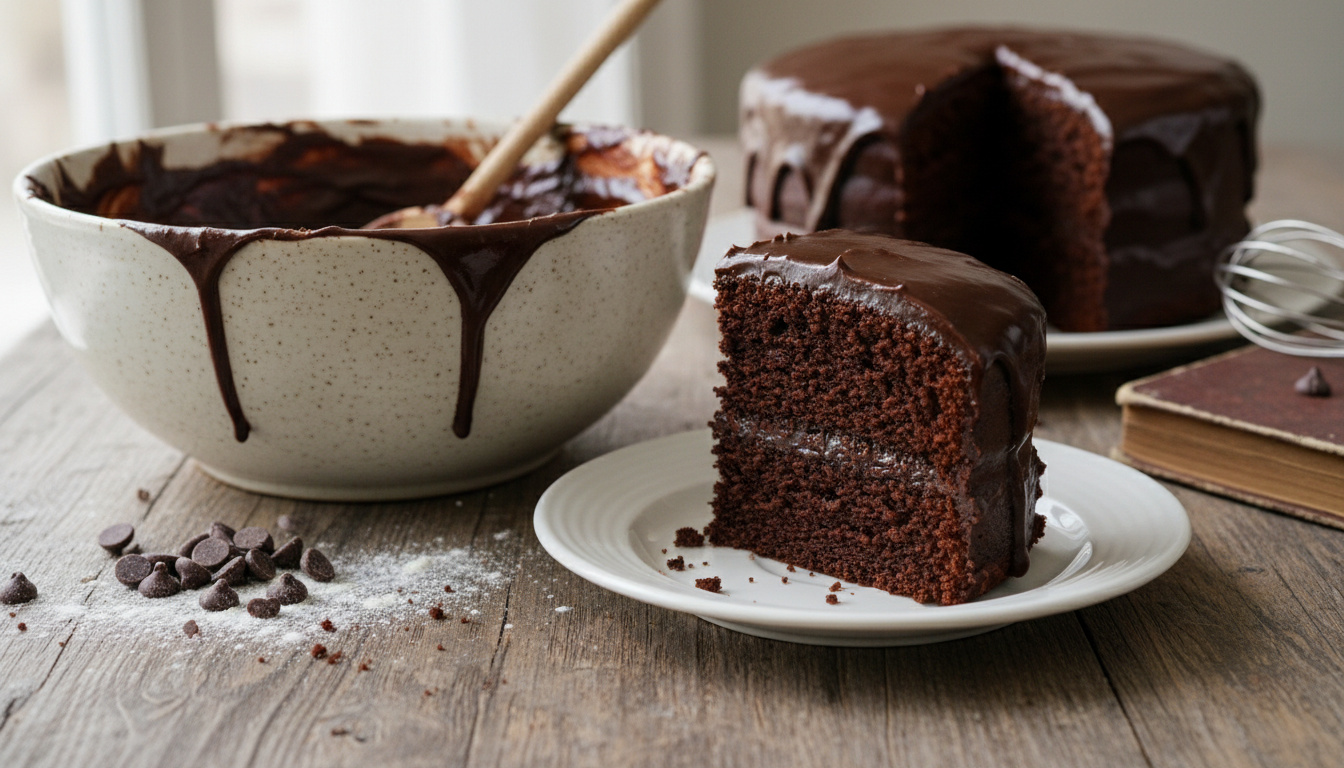
The perfect chocolate cake balances rich cocoa depth with an irresistibly moist, tender crumb. Modern home bakers increasingly favor streamlined approaches that deliver professional results without complex equipment or hard-to-find ingredients.
One-bowl methods have revolutionized home baking, tracing their lineage to Depression-era “wacky cake” recipes that achieved remarkable tenderness without eggs or dairy. These formulas rely on pantry staples—flour, cocoa powder, vegetable oil, and vinegar—combined through specific chemical reactions rather than mechanical leavening.
Contemporary adaptations maintain this simplicity while accommodating dietary restrictions, offering fully vegan options that rival traditional butter-based cakes in richness and structure.
How to Make Chocolate Cake from Scratch
Prep Time
20 minutes
Cook Time
30-35 minutes
Servings
12 slices
Difficulty
Easy
Mastering foundational technique matters more than expensive ingredients. The following insights distill essential practices from professional test kitchens:
- Hot coffee or water “blooms” cocoa powder, intensifying flavor and creating internal steam for moisture
- Acidic ingredients like vinegar react with baking soda to create lift without eggs
- Vegetable oil replaces butter to ensure lasting tenderness
- One-bowl mixing minimizes gluten development and cleanup
- Natural unsweetened cocoa powder provides necessary acidity for chemical leavening
- Thin, pourable batter consistency ensures even fudgy texture
| Ingredient | Quantity | Notes |
|---|---|---|
| All-purpose flour | 1.5–3 cups (180–390g) | Spooned and leveled, or substitute cake flour |
| Natural cocoa powder | 1/3–3/4 cup (49–60g) | Not Dutch-processed; maintains acidity |
| Sugar | 1–2 cups | White, organic cane, or brown for chewiness |
| Baking soda | 1/2–1.5 tsp | Check expiry date for potency |
| Salt | 1/3–1 tsp | Enhances chocolate flavor |
| Vegetable oil | 1/2–1 cup | Creates tender crumb; do not reduce |
| Hot water or coffee | 1–2 cups | Activates cocoa bloom |
| White vinegar | 2 tsp | Reacts with soda for rise |
| Vanilla extract | 1–1.5 tsp | Pure extract preferred |
| Optional: Applesauce | 1/2 cup | Adds moisture without fat |
What Makes a Chocolate Cake Moist and Fudgy
Texture in chocolate cake depends on fat selection, liquid temperature, and protein content. Unlike butter-based cakes that solidify when cooled, oil-based formulas remain supple at room temperature, contributing to the characteristic fudgy mouthfeel associated with professional bakery cakes.
The Science of Hot Liquid Blooming
Adding hot coffee or water directly to cocoa powder triggers a chemical process called blooming, which releases aromatic compounds and dissolves cocoa solids into a smooth paste. This technique, emphasized by vegan baking specialists, creates a more intense chocolate flavor while generating steam during baking that opens the crumb structure.
Flour Selection and Gluten Management
All-purpose flour provides adequate structure for layer cakes, though cake flour yields a more delicate crumb due to lower protein content. When substituting whole wheat flour for a healthier option, increasing liquid by approximately ten percent prevents dryness, according to recipe developers specializing in eggless baking.
Natural unsweetened cocoa powder maintains the acidity necessary to react with baking soda. Dutch-processed cocoa, treated with alkali, may prevent proper rising in recipes dependent on acid-base reactions.
Can You Make Chocolate Cake Without Eggs?
Eggless chocolate cakes rely on acid-base chemistry to create structure and lift. When vinegar or acidic dairy alternatives interact with baking soda, they produce carbon dioxide bubbles that expand during baking, mimicking the leavening function of whipped eggs.
The Vinegar Reaction Method
Combining white vinegar with baking soda creates an immediate chemical reaction that generates air pockets. This method, dating to wartime rationing recipes, produces reliable results without the binding properties of eggs. The one-bowl technique developed during this era remains popular for its simplicity and consistent texture.
Vegan Buttermilk Alternatives
Curdling non-dairy milk with vinegar or lemon juice for five to seven minutes creates a buttermilk substitute that adds tang and activates baking soda. Soy or oat milk provides the best curdling consistency, though hot water or coffee can replace liquid dairy entirely in oil-based recipes.
Step-by-Step Baking Guide and Tips
Success requires precise temperature control and minimal handling. Overmixing develops gluten strands that create toughness rather than tenderness.
Mixing Technique
Whisk dry ingredients thoroughly in a single large bowl. Create a well in the center, add wet ingredients, and stir until just combined. The batter should remain thin and pourable; thick batter indicates insufficient liquid or over-measured flour. Instructional guides emphasize stopping when flour streaks disappear rather than pursuing completely smooth batter.
Expired baking soda fails to produce adequate rise. Test potency by adding a pinch to vinegar; active soda fizzes immediately. Overmixed batter results in dense, rubbery cake rather than the desired tender crumb.
Baking Temperature and Timing
Bake at 350°F (175°C) for 15 to 30 minutes depending on pan size. Single layers in 8-inch rounds require 20 to 30 minutes, while thinner sheets may set in 15 to 20 minutes. Baking tests recommend inserting a skewer at the minimum time; wet batter indicates continued baking, while clean removal signals doneness.
At elevations above 3,000 feet, reduce baking powder and soda by 1/4 teaspoon, increase liquid by 2 to 4 tablespoons, and raise oven temperature to 375°F to set structure before gases escape.
Cooling and Storage
Cool cakes in pans for exactly 10 minutes to allow structure to set, then transfer to wire racks. Storage at room temperature under a cake dome maintains moisture for two to four days, while refrigeration extends freshness to five to seven days for frosted cakes.
Baking Timeline
- Preparation (0-20 minutes): Measure ingredients, preheat oven to 350°F, prepare pans with parchment and oil.
- Mixing (5-10 minutes): Whisk dry ingredients, add wet ingredients, stir until just combined.
- Baking (15-30 minutes): Pour batter into prepared pans, bake until skewer tests clean.
- Cooling (60 minutes): Rest in pan 10 minutes, invert onto rack, cool completely before frosting.
- Frosting (15 minutes): Apply ganache, buttercream, or fudge frosting to cooled layers.
Common Mistakes to Avoid
Understanding variable factors helps prevent disappointing results. While core chemistry remains constant, environmental conditions affect outcomes.
| Established Facts | Common Uncertainties Requiring Adjustment |
|---|---|
| Oil creates tender crumb; butter provides structure | Exact baking time varies by pan material and oven calibration |
| Natural cocoa reacts with soda; Dutch-processed requires different leavening | Humidity affects flour absorption rates |
| Hot liquid blooms cocoa flavor | High altitude necessitates specific adjustments |
| Vinegar and baking soda create rise without eggs | Freshness of leavening agents determines lift consistency |
| Overmixing develops gluten and toughness | Cooling time affects frosting adhesion |
Why This Recipe Works
The interplay between acid and base drives the recipe’s success. Baking soda requires acidic partners—vinegar, natural cocoa, or yogurt—to generate carbon dioxide. Without this pairing, the cake remains dense and flat.
Oil-based formulas differ fundamentally from creamed butter cakes. Where butter creates air pockets through mechanical creaming and solidifies when cool, oil remains liquid at room temperature, coating flour proteins and limiting gluten formation. This results in the Tuesdays with Morrie – True Story Summary and Lessons characteristic moistness that persists for days.
The thin batter consistency ensures even heat penetration, preventing the dry edges and soggy centers common in thick, egg-heavy mixtures. Unlike workplace dynamics described in Hostile Work Environment – Definition Examples Proof Steps, baking chemistry follows predictable patterns when ratios remain consistent.
Expert Tips and Sources
Professional bakers emphasize ingredient quality and measurement precision. Visual demonstrations confirm that natural cocoa powder produces superior rise compared to Dutch-processed varieties in eggless recipes.
The reaction between acid and baking soda must occur in the oven, not on the counter. Adding vinegar to hot liquid immediately before baking preserves leavening power.
— Baking Science Analysis
Unfrosted layers wrapped tightly in plastic maintain quality for three months in freezer storage. Thawing overnight at room temperature preserves texture better than microwave defrosting.
— Food Preservation Guidelines
Variations and Next Steps
Mastering the base recipe opens possibilities for customization. Fold semi-sweet chocolate chips or toasted nuts into batter before baking for textural contrast. For layer cakes, bake in three 8-inch rounds and stack with ganache or vegan buttercream. Wheat flour substitutions require increased liquid monitoring, while reduced sugar versions benefit from additional vanilla to maintain flavor perception.
Frequently Asked Questions
What is the best chocolate cake recipe?
Recipes using one-bowl mixing, natural cocoa, hot coffee for blooming, and oil rather than butter consistently produce the moistest, most tender results with minimal effort.
How long to bake chocolate cake?
Standard 8-inch layers require 20 to 30 minutes at 350°F, while single sheet cakes may need only 15 to 20 minutes. Test with a skewer at the minimum time.
Can I use Dutch-processed cocoa powder?
Dutch-processed cocoa lacks the acidity needed to react with baking soda. If substituting, add 1/2 teaspoon cream of tartar or use baking powder instead.
Why did my cake sink in the middle?
Sinking typically indicates underbaking, expired leavening agents, or opening the oven door during the first 20 minutes of baking, which causes temperature shock.
How do I store leftover cake?
Store unfrosted or frosted cake at room temperature under a dome for 2-4 days, refrigerate for 5-7 days, or freeze unfrosted layers for up to 3 months.
Can I make this in a different pan size?
This recipe adapts to 8-inch rounds, 9-inch squares, or bundt pans. Adjust baking time accordingly—deeper pans require longer baking, while thinner sheets bake faster.
Related stories




Liam O'Brien covers Australian politics and public affairs for Aussie Briefly.