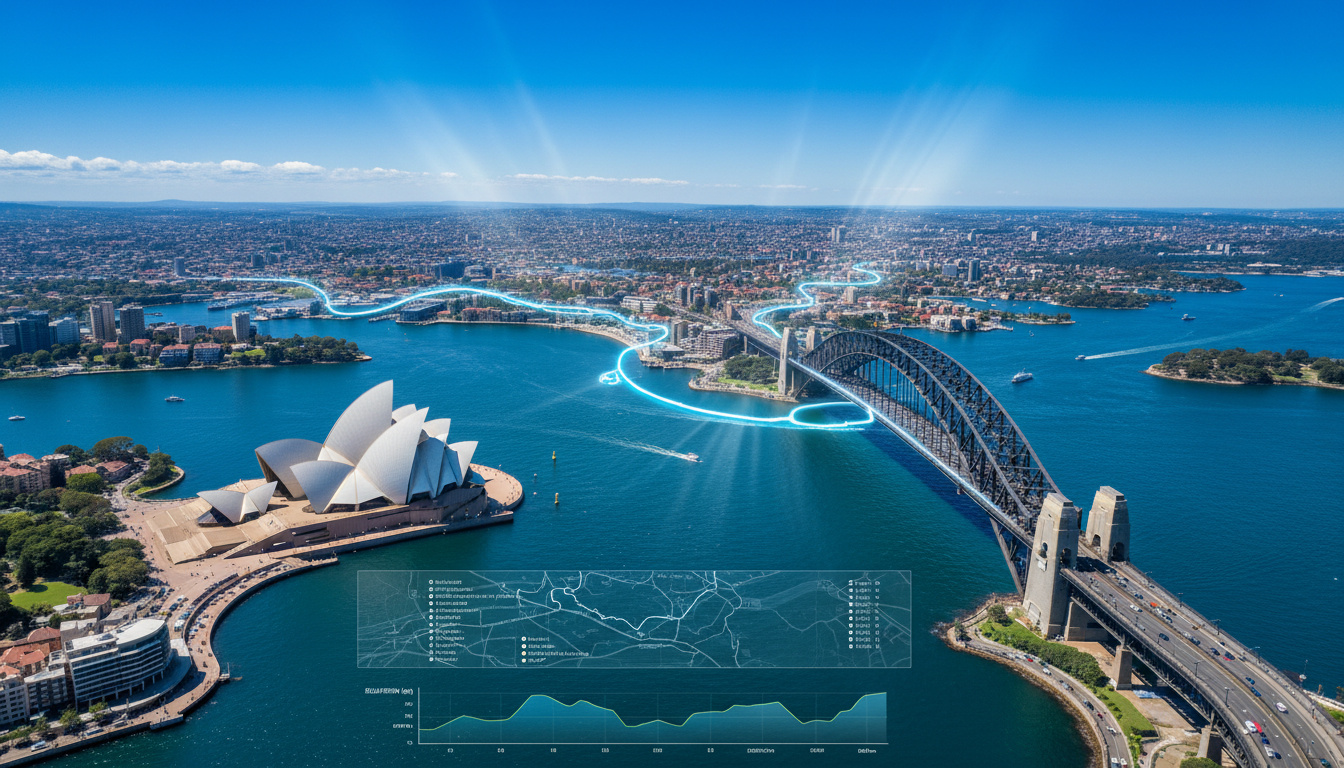

The TCS Sydney Marathon covers 42.195 kilometres through Australia’s largest city, combining urban landmarks with harbour views. Runners traverse from North Sydney to the Opera House across a point-to-point course certified by World Athletics and distinguished by a net elevation loss of 83 metres.
The route demands strategic pacing across varied topography. With 313 metres of total climbing concentrated in the eastern suburbs, participants encounter both sweeping descents and challenging rises through Centennial Park and Anzac Parade before the final approach to the Sydney Opera House.
Understanding the official track layout proves essential for training and race-day planning. This guide examines the certified course, elevation profiles, and logistical details based on data from the event organisers and independent topographical surveys.
What is the Sydney Marathon Route?
- Early crossing of Sydney Harbour Bridge within the first 3 kilometres
- Passage through multiple CBD precincts with designated spectator zones at 11.9 km and 13.1 km
- Out-and-back segment along Anzac Parade between kilometres 16 and 28
- Centennial Park loop segment between kilometres 30 and 34
- Final approach features a notable rise at Mrs Macquarie’s Chair before the finish descent
- Drink stations positioned every 5 kilometres supplying Powerade
- GPX files available for download with precise horizontal routing
| Attribute | Specification |
|---|---|
| Official Distance | 42.195 km |
| Start Elevation | ~61 metres above sea level |
| Finish Elevation | ~26 metres above sea level |
| Net Elevation | -83 metres |
| Total Gain | +313 metres |
| Total Loss | -396 metres |
| Start Location | Miller Street, North Sydney |
| Finish Location | Sydney Opera House |
| Bridge Crossing | Sydney Harbour Bridge (km 2-3) |
| Maximum Gradient | 3-7% (Anzac Parade segments) |
| Aid Stations | Every 5 km (Powerade at 5/10/15/20/25/30/35/40 km) |
| Course Certification | World Athletics |
Where Does the Sydney Marathon Start and Finish?
Start Line Logistics
Miller Street beside North Sydney Oval serves as the start point, a location deliberately echoing the Sydney 2000 Olympic Games heritage. Runners head south immediately toward the harbour, crossing the Sydney Harbour Bridge between kilometres 2 and 3.
Finish Area Configuration
The course terminates on the forecourt of the Sydney Opera House, with runners descending Macquarie Street for the final approach. This creates a spectator-friendly finale with views of the harbour, though the preceding kilometre includes a rise past the Royal Botanic Gardens.
The Miller Street start sits adjacent to North Sydney Oval, the same precinct used during the Sydney 2000 Olympic Games marathon events.
Transport and Access Considerations
The point-to-point nature requires planning for transport between North Sydney and the CBD. Competitors should note that the finish area differs significantly from the start, necessitating either bag-drop services or public transport arrangements. For medical facility locations near the harbour, runners may consult the John Hunter Hospital – Location Services Contact Guide for regional hospital standards, though St John Ambulance stations line the course itself.
Is the Sydney Marathon Route Flat?
Elevation Profile Analysis
Official data indicates the course is moderately hilly rather than flat. FindMyMarathon elevation data updated in March 2025 confirms a minimum elevation of 5 metres and maximum of 89 metres, contradicting assumptions of a uniformly level urban course.
Key Challenging Segments
Anzac Parade features a pronounced descent and return climb between kilometres 16 and 28. The approach to the finish presents a sharp rise at Art Gallery Road and Mrs Macquarie’s Chair around kilometre 40, requiring reserved energy for the final 2.195 kilometres.
Third-party GPS tracking records higher elevation gain than official surveys. Discrepancies arise from GPS measurement methods versus professional surveys. Always prioritise official TCS figures for pacing strategy.
Comparative Difficulty
Gradient analysis shows segments ranging from 3-7%, with some sections exceeding 7% steepness. This classification places the Sydney course among the more topographically varied major city marathons, despite the net downhill profile.
Sydney Marathon Route Map and GPS
Official Mapping Resources
Interactive digital maps provided by the organisers show precise drink station locations marked with “W+” icons at 5 kilometre intervals. These resources display the full 42.195 kilometre trace with closed-road indicators.
Downloadable Files
Organisers offer GPX downloads for GPS devices. While the route tracing is 100% accurate, the elevation data within these files is approximate. PDF elevation charts showing kilometre-by-metre profiles remain available for precise gradient planning.
Official GPX files provide precise horizontal routing but carry approximate elevation data. For accurate gradient planning, consult the certified elevation profile PDF published by the organisers.
Third-Party Tracking
Strava hosts user-generated route data showing a 42.7 kilometre variant with 660 metres gain. These community files offer additional perspective but should not replace official measurements for race planning.
Key Landmarks by Kilometre
The marathon route passes significant Sydney landmarks in sequence. Official course documentation establishes the following progression:
- Kilometres 0-3: Miller Street start and Sydney Harbour Bridge crossing
- Kilometres 3-11: The Rocks, Circular Quay, and CBD approach
- Kilometres 11.9-13.1: Major CBD spectator zones
- Kilometre 15.4: Taylor Square party zone featuring Pride in Sport activation
- Kilometres 16-28: Anzac Parade out-and-back passing Moore Park and Allianz Stadium
- Kilometre 29.4: Sydney Swans Zone near the cricket precinct
- Kilometres 30-34: Centennial Park loop via Driver Avenue
- Kilometre 40: Hyde Park and Art Gallery Road ascent
- Kilometres 41-42.195: Final descent to Sydney Opera House finish
Verified Course Data vs. Unconfirmed Details
Established Information
- Official distance of 42.195 km certified by World Athletics
- Net elevation loss of 83 metres (start 61m, finish 26m)
- Start at Miller Street, North Sydney; finish at Opera House
- Drink stations at 5km intervals (5, 10, 15, 20, 25, 30, 35, 40 km)
- Harbour Bridge crossing within first 3 km
Information Remaining Unclear
- Precise 2026 route modifications (awaiting organiser confirmation)
- Final kilometre timing mat positions for 2025 onward
- Specific half marathon divergence point exact coordinates
- Real-time weather contingency routing protocols
How the Route Fits Sydney’s Sporting Heritage
The course design deliberately echoes the Sydney 2000 Olympic Games marathon route, utilising the same North Sydney start precinct near the Oval. This connection to Olympic heritage distinguishes the event within Australia’s running calendar.
Recent modifications have streamlined the course flow. Post-2020s updates removed tight Darling Harbour and Pyrmont turns in favour of straighter CBD passages, reducing U-turns and improving potential for faster times. The AFL Grand Final Score – Brisbane Lions Win 120-60 Over Sydney represents another major sporting result from the same period, demonstrating the city’s active major event calendar alongside the marathon’s harbour-side course.
The 2025 elevation data, updated on 10 March 2025, indicates no major route shifts from the 2024 configuration, though runners should verify final details prior to race day.
Data Sources and Official Measurements
The GPX route is 100% accurate, while the elevation file is approximate. Runners should consult official PDF maps for precise gradient planning.
— TCS Sydney Marathon Official Course Documentation
Elevation data updated 10/03/2025 showing minimum 5 metres and maximum 89 metres above sea level across the course profile.
— FindMyMarathon Elevation Database
Final Preparation Checklist
Successful completion of the TCS Sydney Marathon requires familiarity with the 42.195 kilometre route from Miller Street to the Opera House, accounting for the 313 metres of elevation gain concentrated in the eastern suburbs. Runners should download official GPX files for device compatibility, study the Anzac Parade and Centennial Park segments for pacing, and arrange transport between the point-to-point start and finish.
Frequently Asked Questions
Where exactly does the Sydney Marathon start?
The marathon begins on Miller Street in North Sydney, adjacent to North Sydney Oval. This location holds Olympic heritage significance from the Sydney 2000 Games.
Is the Sydney Marathon route completely flat?
No. Despite a net elevation loss of 83 metres, the course features 313 metres of total climbing with gradients between 3-7% on segments like Anzac Parade.
Can I download the Sydney Marathon GPX file?
Yes. Official GPX downloads are available from the organiser’s website. The horizontal route data is 100% accurate, though elevation data within the file is approximate.
How does the half marathon route differ from the full?
The half marathon shares initial sections with the full marathon but diverges at an unspecified point before the full 42.195 kilometre distance. Specific divergence coordinates are not detailed in official documentation.
What is the total elevation gain?
Official TCS data records +313 metres of elevation gain with -396 metres of loss, resulting in a net -83 metres from start to finish.
Are there significant hills in the final kilometres?
Yes. Kilometre 40 features a rise at Art Gallery Road and Mrs Macquarie’s Chair before the final descent to the Opera House finish line.
Has the Sydney Marathon route changed recently?
Post-2020s updates improved flow by removing tight Darling Harbour turns. The 2025 route shows no major shifts from 2024, though minor adjustments remain possible.
Related stories




Liam O'Brien covers Australian politics and public affairs for Aussie Briefly.