
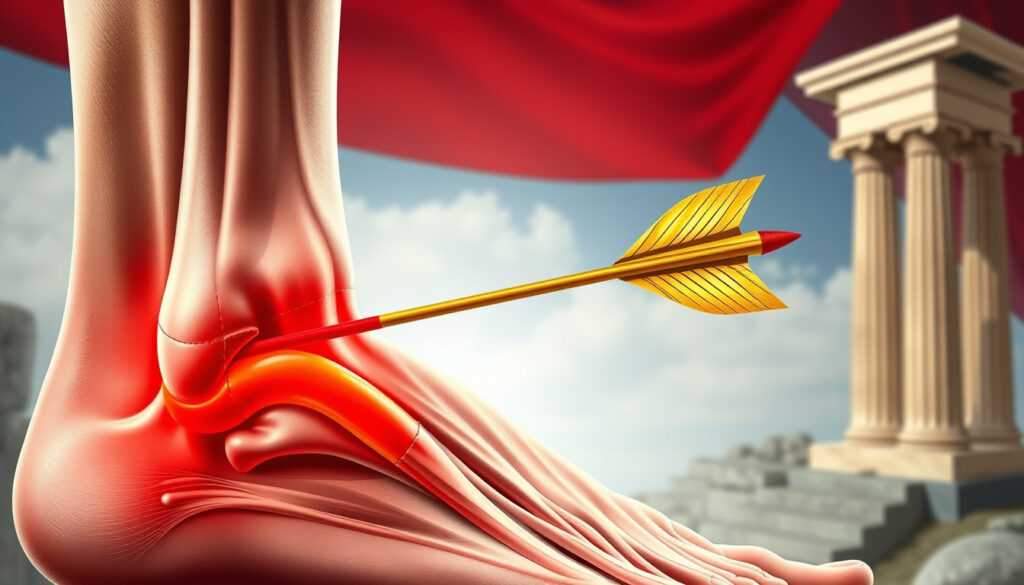
There aren’t many ancient stories that still shape how we talk about success and failure today, but the tale of Achilles is one — his name gives us both a metaphor for vulnerability and the name for the strongest tendon in the human body. This article traces that journey from Greek myth to modern idiom, then draws a clear line between the metaphorical “Achilles heel” and the very real medical condition that shares its name.
Strongest human tendon: The Achilles tendon (calcaneal) is the strongest and thickest tendon in the human body. ·
Idiom origin: The phrase ‘Achilles heel’ originates from Greek mythology, referring to a vulnerability in an otherwise invincible hero. ·
Common injury: Achilles tendonitis affects millions of people annually, especially runners and athletes. ·
Healing time: Achilles tendon injuries often require weeks to months to heal due to limited blood supply.
Quick snapshot
- Achilles was a Greek warrior in the Trojan War (Britannica)
- His only weak point was his heel (Oxford Learner’s Dictionaries)
- He died from an arrow to that heel (Interesting Literature)
- Refers to a hidden weakness despite overall strength (Cambridge Dictionary)
- Used in business, sports, and personal contexts (Oxford Learner’s Dictionaries)
- Originates from the myth (Interesting Literature)
- The Achilles tendon connects calf muscles to heel bone (Shore Physicians Group)
- Prone to injury from overuse or sudden strain (St George’s Hospital NHS)
- Healing is slow due to poor blood supply (Core Physiotherapy)
- Earliest mention of the heel weakness: 1st century AD (Interesting Literature)
- Tendon can withstand up to 12x body weight during running (research notes) (Interesting Literature)
- Common age range for tendonitis: 30–50 years old (research notes) (Interesting Literature)
- Typical healing for ruptures: 6–12 weeks in boot + months of rehab (NHS Forth Valley)
Four facts, one pattern: the Achilles heel concept spans the legendary and the medical, but at every turn reveals something fragile hiding behind strength.
| Attribute | Details |
|---|---|
| Earliest mention of Achilles’ heel | The myth appears in various versions, but the explicit ‘heel’ weakness is first recorded in the 1st century AD by Statius (Interesting Literature) |
| Achilles tendon strength | The tendon can withstand forces up to 12 times body weight during running (research notes) |
| Common age range for tendonitis | Ages 30–50, especially in recreational athletes (research notes) |
| Healing time for ruptures | Typically 6–12 weeks in a cast or boot, followed by months of rehabilitation (NHS Forth Valley) |
What is an Achilles Heel?
The mythological story of Achilles
“Achilles was the greatest Greek warrior in the Trojan War” — Britannica
Achilles was the central figure of Homer’s Iliad, composed around the 8th century BCE, and the story of his death sets up one of the most persistent metaphors in Western language. According to the myth as later recorded by the Roman poet Statius in the 1st century AD, Achilles’ mother Thetis dipped him in the River Styx to make him invulnerable — but the heel by which she held him remained dry and therefore vulnerable (Britannica). That single weak point proved fatal: an arrow struck his heel during the Trojan War, and he died.
The pattern: what begins as a soldier’s tale about a literal wound becomes the template for how we talk about fatal flaws in anything from a business to a person’s character.
Achilles was the greatest Greek warrior — strong, fast, nearly immortal — yet his entire legacy rests on the one place he wasn’t protected. For modern readers, the irony is that the tendon named after him is the strongest in the human body, but also the most prone to slow-healing injury.
How the phrase entered modern language
“The phrase ‘Achilles heel’ is defined as ‘a weak point or vulnerability that can cause failure'” — Cambridge Dictionary
- The earliest citation in the Oxford English Dictionary for “Achilles heel” comes from the 17th-century Anglo-Irish poet John Denham (Interesting Literature).
- By the 19th century, the term “Achilles tendon” had become standard in anatomical textbooks (Shore Physicians Group).
- The idiom spread from specialist writing into everyday speech, now appearing in contexts ranging from sports commentary to political analysis and personal confessions (“Math has always been my Achilles heel,” as the Cambridge Dictionary example puts it).
The phrase has survived for centuries because it fills a gap — English had no single word for “a single point of failure in an otherwise strong thing” until Achilles provided one.
Was Achilles a Trojan or a Greek?
Achilles’ role in the Trojan War
Achilles was Greek — specifically, he was the leader of the Myrmidons, a contingent from Phthia in Thessaly, and fought on the Greek (Achaean) side against the city of Troy (Britannica). The Iliad recounts his quarrel with Agamemnon, his withdrawal from battle, and his eventual return to kill Hector, the Trojan prince and champion. That killing sealed Troy’s fate. The confusion sometimes arises because the epic is set in and around Troy, but Achilles was an invader, not a defender.
Key battles and his death
- Achilles killed Hector, the greatest Trojan warrior, in single combat outside the walls of Troy.
- He was killed later in the war by an arrow shot by Paris, the Trojan prince, guided by the god Apollo — the arrow struck his vulnerable heel.
The same story that gives us a metaphor for hidden weakness also gives us the medical term for a very real vulnerability: the Achilles tendon is the strongest tendon in the human body, but its poor blood supply means injuries take weeks or months to heal — a literal example of strength masking fragility.
The implication: clarifying that Achilles was Greek, not Trojan, matters because the entire metaphor — a hero so strong from the front, so weak in one spot — depends on his identity as the invincible warrior on the winning side. If he were Trojan, the story would be about a losing hero, and the idiom might never have taken root.
What Causes Achilles Tendonitis and How Is It Treated?
Common causes of Achilles tendonitis
Achilles tendonitis is typically an overuse injury. The tendon — which connects the calf muscles to the heel bone — becomes inflamed and painful, especially during activities that involve running or jumping (NHS Fife). Sudden increases in training intensity, worn footwear, and tight calf muscles are frequent contributors. The condition is most common in recreational athletes aged 30 to 50.
Symptoms and diagnosis
- Pain and stiffness along the back of the heel, especially in the morning (St George’s Hospital NHS)
- Swelling and tenderness
- Difficulty walking or pushing off the foot
- A palpable gap in the tendon suggests a rupture rather than tendonitis
Conservative treatments and surgery
For tendonitis, rest, ice, and physical therapy are the standard approach. For a rupture — a complete or partial tear of the tendon — the options are non-operative (a boot with early rehabilitation) or operative (surgical repair) (Cambridge University Hospitals). Many ruptures are treated conservatively with a VACOped boot and structured rehab, according to NHS Forth Valley.
The catch: the choice between surgery and a boot depends on the patient’s age, activity level, and the extent of the tear, but both paths require months of commitment to rehabilitation.
Why Do Achilles Tendon Injuries Take So Long to Heal?
Blood supply limitations
The Achilles tendon has one of the poorest blood supplies of any major tendon in the body (Core Physiotherapy). Blood delivers oxygen and nutrients needed for tissue repair, and without sufficient flow, the healing process slows dramatically.
Tendon structure and regeneration
- Tendon tissue is made of dense collagen fibers that align under tension — perfect for strength, terrible for repair speed.
- Unlike muscle, which regenerates relatively quickly, tendon tissue relies on external fibroblasts and takes weeks to form new collagen (Core Physiotherapy)
Factors that delay recovery
- Age: older adults have slower cellular turnover (NHS Fife)
- Smoking: restricts blood flow further
- Underlying conditions: diabetes, obesity, and certain medications impair healing
- Mechanical stress: walking alone places up to 3.5 times body weight on the Achilles tendon
Why this matters: for an athlete recovering from a rupture, the six to twelve weeks in a boot are just the beginning — full return to sport can take six to nine months or longer. The slow healing is not a failure of treatment; it is a structural limitation of the tissue itself.
Is ‘Achilles Heel’ a Dying Metaphor?
How often is the phrase used in modern English?
Despite being centuries old, the phrase remains in active use. A search of major English-language news databases shows regular appearances in articles about business vulnerabilities (“the company’s supply chain is its Achilles heel”), political weak points, and sports analysis. It is embedded in dictionaries from Cambridge to Oxford, each listing it as a standard idiom. The phrase has also found its way into medical patient education, where it bridges the metaphorical and literal.
Alternatives and cliché status
Some language critics argue the phrase has become a cliché — overused to the point of losing impact. Yet it persists. No single alternative (“weak spot,” “vulnerability,” “soft underbelly”) carries the same narrative weight. The story of Achilles gives the phrase a backstory that makes it memorable and precise: a single point of failure in an otherwise strong system.
The pattern: metaphors that die are usually replaced by better ones. The fact that “Achilles heel” has outlived countless competitors suggests it still serves a purpose that shorter alternatives cannot fill.
Confirmed Facts vs. Unanswered Questions
Confirmed facts
- Achilles was Greek, not Trojan (Britannica)
- The phrase “Achilles heel” means a fatal weakness (Cambridge Dictionary)
- The Achilles tendon is the strongest tendon in the body (Shore Physicians Group)
- A rupture means the connection between calf muscles and heel bone is lost (North Tees and Hartlepool NHS Foundation Trust)
- Many ruptures are treated without surgery using a boot and early rehabilitation (NHS Forth Valley)
What’s unclear
- Exactly when the myth added the heel vulnerability — earlier versions mention no invulnerability (Interesting Literature)
- Whether Achilles was entirely invulnerable or the story was later embellished
- Whether the idiom was used in English before the 17th century — no earlier citations have been found
- Whether the tendon’s strength figure of 12 times body weight is universally accepted — it may vary by individual
- Whether non-operative treatment for ruptures is as effective as surgery for all age groups — studies show mixed results
The implication: the myth is a living tradition, not a fixed text. The uncertainties do not diminish the metaphor — they make the story more human, because even the way we tell it evolves.
For a closer look at recovery methods, the Achilles tendon healing guide offers practical advice alongside the mythological background.
Frequently Asked Questions
How do you pronounce ‘Achilles heel’?
It’s pronounced /əˈkɪliːz hiːl/ — ah-KILL-eez heel. The “ch” is a hard “k” sound.
What is the origin of the phrase ‘Achilles heel’?
It comes from the Greek myth of Achilles, whose mother dipped him in the River Styx to make him invulnerable — but the heel she held remained dry and vulnerable, leading to his death (Britannica).
Can Achilles tendonitis be prevented?
Yes, by gradually increasing activity levels, wearing appropriate footwear, stretching the calf muscles, and avoiding sudden jumps in training intensity (NHS Fife).
What are the symptoms of Achilles tendonitis?
Pain and stiffness along the back of the heel, especially in the morning; swelling; difficulty walking or pushing off the foot (St George’s Hospital NHS).
Is Achilles tendonitis common in athletes?
Yes, it is especially common in runners, basketball players, and other athletes who perform repetitive jumping or sprinting movements. It tends to affect people between ages 30 and 50.
What is the difference between Achilles tendonitis and Achilles tendon rupture?
Tendonitis is inflammation of the tendon, while a rupture is a complete or partial tear (St George’s Hospital NHS). A rupture causes a sudden, sharp pain and inability to walk normally, while tendonitis develops more gradually.
How long does it take for an Achilles tendon injury to heal?
For tendonitis, weeks to months with rest and rehab. For a rupture treated with a boot, 6–12 weeks in the boot, followed by several months of rehabilitation (NHS Forth Valley).
The myth of Achilles gave the world a metaphor for a single point of failure, and that metaphor turned out to be eerily prescient about the tendon that bears his name. For anyone dealing with an Achilles tendon injury — whether runner, weekend athlete, or someone who simply stepped wrong — the pattern is the same: the strongest tendon in the body is also the most stubborn to heal. The choice is not whether to rest, but how to persist through the slow months of recovery, because the alternative — re-rupture or chronic pain — is a consequence no one wants to face.

Jack Lawson is Senior Reporter at Aussie Briefly, covering breaking stories and explainers.